
It looks like it has finally happened. Victoria’s Secret has pivoted toward inclusivity, diversity, and empowerment, seeking to de-center the male fantasy focus. The iconic Angels, once the epitome of “thin, tall, fair”, are now joined by women of varied bodies, backgrounds, gender identities and ages. After years of mounting criticism, tanking viewership and cultural backlash, the brand’s return in 2024 felt like more than nostalgia; It suggested something foundational was evolving. But what kind of change? And has the 2025 show confirmed that the rebrand is more than a marketing facelift?
Because the 2025 Victoria’s Secret Fashion Show, live from New York on October 15, delivers both affirmation and friction. Affirming the shift toward a new audience focus but raising new questions about whether the core fantasy has truly been reimagined. This article argues that the rebranding of Victoria’s Secret Fashion Shows reflect a significant cultural shift in how femininity is imagined, marketed and consumed. By examining the show’s makeover, its reoriented target audience, and debates surrounding its authenticity, it becomes clear that the new Victoria’s Secret is not only trying to repair brand reputation but also responding to a broader redefinition of femininity in contemporary media.
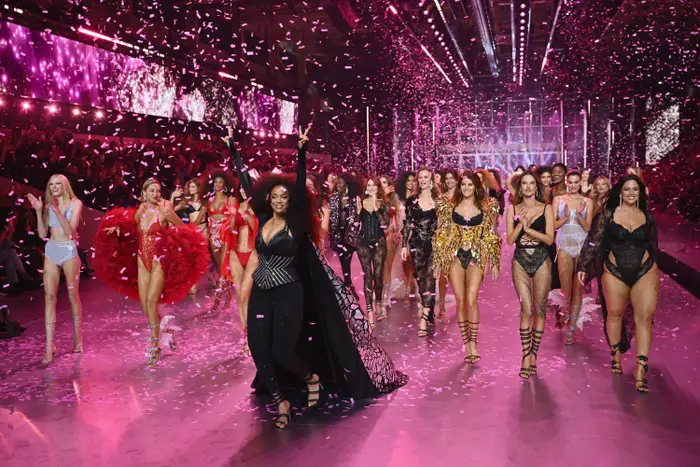
Photo : Getty Images
The Fall of the ‘Traditional’ Angels
When the VS Fashion Show first launched in the 1990s, it epitomised the “sex sells” advertising ethos. Marketed as glamorous and aspirational, the brand’s ‘Angels’ become cultural icons. Personally, watching the annual Victoria’s Secret Fashion show was a tradition I shared with my sisters growing up. However, this celebration of hypersexualised beauty was narrow in scope as models were overwhelmingly thin, fair and tall. For years, this organisation has promoted the fantasy that women should aspire to meet this ideal, while simultaneously targeting heterosexual male spectatorship.
This marketing framework worked in an era where televised events drew mass audiences, but by the 2010s, the cultural climate began to shift. Critics argued that the brand was out of step with movements for body positivity, inclusivity and diversity. The #MeToo era increased sensitivity toward the objectification of women, and Victoria’s Secret faced negative backlash for promoting unattainable beauty standards, (Clark, 2023). Viewership of the show steadily declined, dropping from 9.7 million viewers in 2013 to 3.3 million in 2018, (Vogue, 2024). Disappointingly, brand executives at Victoria Secret resisted calls for inclusivity; infamously stating in 2018 that the show would never feature models that are plus-sized or transgender, (Saint-Louis, 2021). By 2019, Victoria’s Secret cancelled its iconic flagship event.
This collapse underscored how the once-successful “sex sells” model no longer aligned with contemporary values. Research shows that the relentless promotion of sexualised thin ideals can negatively affect women’s body image and self-esteem, (Chrisler et al., 2013).
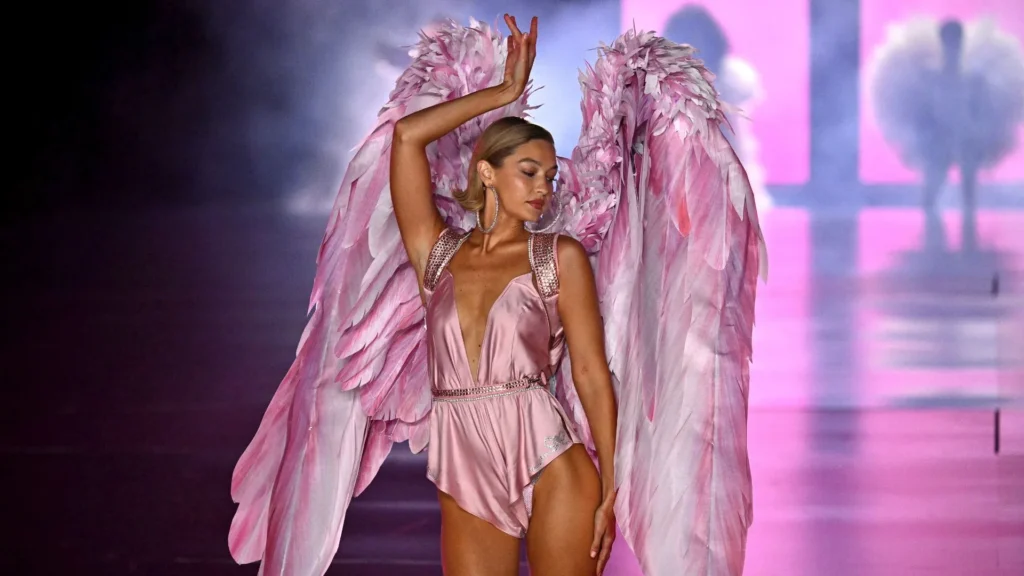
Photo: Getty Images
Victoria Got A Facelift
Let’s be real, the old VS show wasn’t exactly made for women. It was a glitter-covered fantasy designed to please the male gaze. All wrapped up in crystal lingerie sets and feathers. When the show returned in October 2024, it did so with great fanfare but also with a clear attempt at reinvention. Different from past shows, the event highlighted inclusivity and empowerment. Vogue (2024) reported that the revamped show featured a broader range of models, including plus-sized women, women of color, and transgendered women like Alex Consani. Allure (2024) noted the inclusion of models like Paloma Elsesser, symbolises a departure from the “one-size-fits-all” model. The brand also emphasised storytelling, framing each segment around themes of creativity and individuality rather than seduction.
This rebranding reflects a conscious pivot toward a female-centered gaze. As Marie Claire (2025) explained, the new Victoria’s Secret aims to resonate with women who once felt excluded. Newly adopting the language of empowerment and authenticity. Where the VS Angels once strutted as objects of desire, the new production and messaging seeks to celebrate femininity in diverse and realistic forms. Whether it is playful, powerful or vulnerable, the dominating organisation is attempting to redirect its messaging. In 2024, executive vice president, Sarah Sylvester, stated that the new VS show intends to emphasise the models as women rather than having what they wear on that runway being the main focus.
In marketing terms, this is a clear case of shifting the target audience. While the old fashion shows targeted heterosexual males as much as women, the new approach positions women themselves as the primary consumers. Elle (2025) framed the relaunch as an attempt to appeal to “the girls and the gays”, audiences that value inclusivity and self-expression. This shift demonstrates how femininity is now being sold as an internal identity instead of an external fantasy that is unattainable. Framing ‘femininity’ as something that women can embody on their own terms and conditions instead of being directed by the masses.
Additionally, this shift fits neatly into Banet-Weiser’s (2018) idea of “empowerment branding”, whereby feminist language and symbols are harvested and repackaged as a marketable value. Making empowerment the main selling point rather than a political program. VS clearly identifies women themselves as its paying customers and by promoting empowerment, confidence and inclusivity, VS reframes its products as symbols of self-expression rather than seduction. Although, let’s remind ourselves that this shift is still commercial at its core. Feminism packaged as a lifestyle to buy into, meaning that while VS now sells to women instead of for men, it continues to monetise the idea of empowerment itself.
Risk For Rebrand : Femininity Sells
The 2024 show was carefully choreographed not just as a comeback, but as a statement. Every musical performance was female-led, with stars like Tyla, Lisa and even the legendary Cher taking the stage. This highlighted a deliberate shift; literally centering women’s voices in a show that had long been critiqued for objectifying them. Simultaneously, Victoria’s Secret leaned on nostalgia by bringing back icons like Adriana Lima and the Hadid sisters. Reminding audiences of the brand’s long standing cultural legacy while trying to reframe it through a new lens. The curated soundtrack of the show drove this message home. The use of Chapel Roan’s unapologetically queer anthem opening the runway was an overt nod to the fact the show was now “for the girls and the gays”. A stark comparison to the 2016 show where the featured musical artist was The Weeknd. Taken together, these choices reflect a balancing act; Honouring tradition while rebranding it for a generation that demands inclusivity and representation.
Unlike the overly sexualised branding of femininity in the past, it is now being presented as multifaceted; Celebration of beauty, but also of individuality, diversity and empowerment. This aligns with broader cultural trends in media and advertising, where brands attempt to connect with consumers through authenticity and shared values rather than fantasy alone, (Marchi, 2012). This strategy in practice may be read as corrective; Acknowledging that women no longer want to be sold an unattainable ideal, Victoria’s Secret now markets the idea that all women can find themselves in its imagery. Additionally, critics argue that this rebranding risks being performative. After all, selling lingerie and intimates remains a commercial enterprise rooted in desire. Can a company that once thrived on exclusion convincingly rebrand itself as inclusive? Clark (2023) suggests that while the rebrand acknowledged cultural shifts, its effectiveness depends on whether consumers view it as genuine, opportunistic or profit focused.
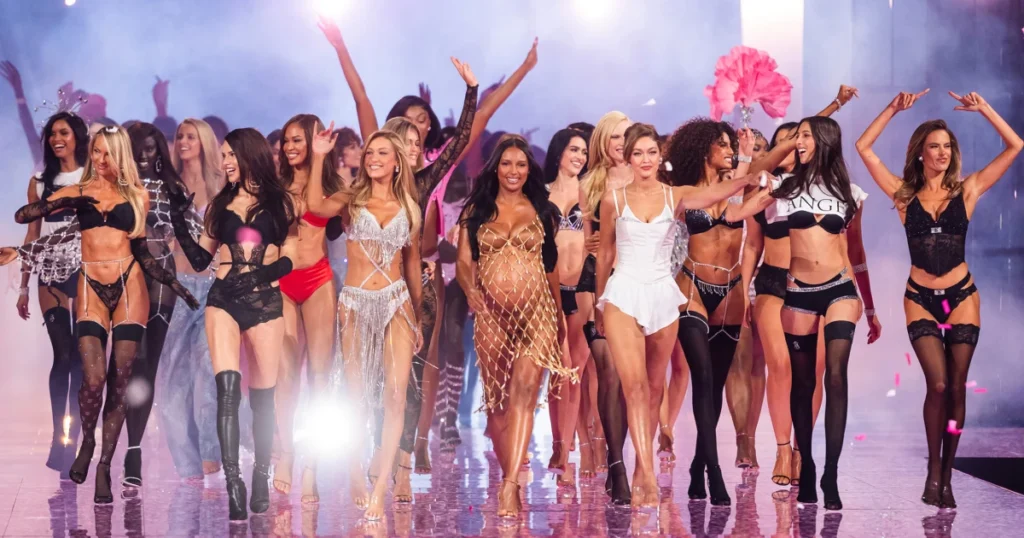
Photo : Getty Images
Message Received ?
However, scepticism remains. Some critics and prosumers argue that Victoria’s Secret is capitalising on feminism without making substantive changes to its corporate structure or labour practices , (Goldhaber, 1997). Others suggest that the empowerment branding can flatten feminist struggles into mere aesthetics. In this view, femininity still sells, but in a way that risks depoliticising deeper issues of gender inequality. The viewers are disappointed by the lack of glamour in comparison to previous shows. Claiming that the empowerment branding was an excuse for a boring production. Although, keep in mind these rebranded VS shows have been made as ready-to-wear off the runway and available for purchase by audiences. The extravagant looks we received prior to the cancellation of the show was purely showcased for entertainment with the intention to build desire. These ‘boring’ looks that we now see on the runway are tailored and designed to be worn by any individual on any given day. Reinforcing the idea that it is no longer ‘fantasy’ but reality.
Moreover, while the inclusion of diverse models challenges traditional beauty standards, the show still emphasises glamour and spectacle. This raises questions; Is the rebrand a true rupture with the past, or simply a softer, more inclusive version of the same formula? Although the multimillion dollar company presents itself as all glitter and glam, selling femininity as a packaged lifestyle remains their core mission.
Lights, Camera, Pose : It’s 2025
The reinvention of the Victoria’s Secret Fashion Show reflects a broader cultural shift in the politics of representation and consumption. The collapse of the “sex sells” era signaled that audiences no longer accept exclusionary ideals of beauty. By pivoting toward “femininity sells” the brand has attempted to rebuild its reputation by aligning with contemporary demands for inclusivity, empowerment and authenticity.
This shift is not without contradictions; Victoria’s Secret remains a global corporation whose ultimate goal is profit, and its embrace of diversity can be read as both progressive and opportunistic. What is clear, however, is the cultural logic of fashion branding has evolved. Today, it is not enough to sell sex; fashion brands must sell values, identity, and belonging in order to survive the current era of cancel culture, (Saint-Louis, 2021).
In this sense, the Victoria’s Secret transformation illustrates a central paradox of contemporary consumer culture. Empowerment is marketed, femininity is commodified, and inclusion itself becomes a brand strategy. Whether the new version of femininity is authentic or performative, it demonstrates how fashion adapts to survive in an ever changing cultural landscape.
VS’s journey from 2018 to 2025 is more than a story about one brand. It mirrors how society is renegotiating what femininity means, how desire is framed, who gets to be labelled as beautiful and what power in visibility feels like. As you scroll feeds, read reviews or watch the runway stream, keep an eye out. Are you seeing more than just diverse faces? Are their stories and presences that command the runway? Does aesthetic and message align?
If you haven’t already, the 2025 Victoria’s Secret Fashion Show that happened this past weekend is up on Youtube and it’s definitely worth the watch. So, what are you waiting for?
 Guan QiuYu
  REN Ren
  Tan Kane