
For decades the music album represented the ultimate statement of artistic vision – a cohesive, narrative experience that defined artists’ identities and cultural eras alike. From Michael Jackson’s Thriller to Beyonce’s Lemonade, albums offered listeners not just songs, but stories, aesthetics and raw emotions woven into a complete unit. Yet, in the past decade, the rise of streaming platforms like Spotify, Apple Music and YouTube Music has drastically changed how audiences consume music. The once ritualistic act of listening to an album from start to finish has been replaced by fragmented consumption, where music functions as an endless, personalised soundtrack rather than a carefully sequenced narrative.
Beginning with the launch of Apple’s iTunes Store in 2003 and the introduction of the 99-cent single, which marked a fundamental shift from album-oriented consumption to track-based sales (Griggs & Leopold, 2013), this moment marked a cultural and economic turning point. The album, once a carefully crafted artistic whole, was reduced to a collection of purchasable fragments. Two decades later, streaming services such as Spotify, Apple Music and YouTube have taken this fragmentation to it’s extreme. As of 2023, streaming accounted for over 67% of global music revenue, reshaping both industry economics and creative practice (Richter, 2023).
While these technological evolutions have democratised access to music, they have also dismantled the album’s role as a meaningful art form. The single, playlist, and the algorithm now dominate where sequence and concept once ruled. What was once an art form centred on narrative cohesion has been replaced by a system that rewards immediacy, quantity and data-driven optimisation.
Critics of the streaming era argue that it has caused the “death of the album” by fragmenting how people consume music and resulting in the dominance of singles (Hesmondhalgh, 2021). The concept of a “body of work” has been overshadowed by a model built on metrics – streams, skips and viral moments – rather than artistic cohesion. Artists no longer rely on cohesive collections of songs to reach audiences, instead they compete for placement in algorithmically generated popular playlists such as Spotify’s “Today’s Top Hit’s”. The listening experience, once guided by artistic intent, is now governed by platform design. The result is a listening culture defined by immediacy and disposability.
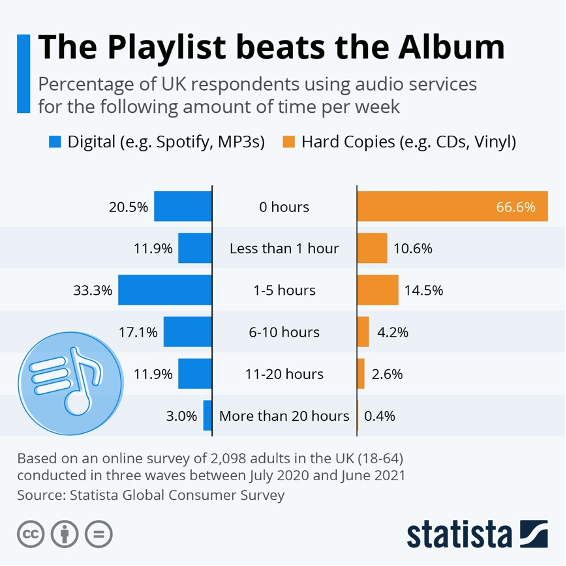
Historically, the album functioned as an art form that demanded patience and deep listening. From the 1960’s onwards, musicians used albums to craft narratives and emotional coherence, encouraging listeners to experience songs as interconnected parts of a greater whole. Classic examples such as Michael Jackson’s Thriller, Lauryn Hill’s The Miseducation of Lauryn Hill and Radiohead’s OK Computer transformed listening into a ritual. Their sequencing of songs, transitions and thematic unity encouraged sustained engagement and emotional immersion. Listening to an album from beginning to end was an act of attention, not convenience.
That immersive culture, however, has largely collapsed under the pressures of digital consumption. A study by Montecchio et al. (2020) analysing “skip profiles” confirm this fragmentation, finding that majority of users skip songs within the first 30 seconds, revealing a decline in engagement with full tracks. Where albums once rewarded patience and cumulative emotional impact, streaming platforms encourage instant reward. This behaviour illustrates how streaming platforms foster a culture of immediacy, where attention is scarce and artists adapt by front-loading songs with hooks to capture listeners instantly (Eriksson et al., 2019). The emotional architecture of songs, once designed to unfold gradually, has been compressed into instantly gratifying sonic bursts. As a result, music itself has been reshaped to service algorithmic preference, producers compress intros, elevate vocal entrances, and maximise rhythmic immediacy to avoid skips. Streaming therefore encourages music to be engineered for instant gratification rather than slow emotional buildup – undermining the very pacing that made albums artful experiences.
Streaming also changes how listeners experience music. Platforms personalise listening through algorithmic recommendation systems, favouring tracks with similar sounds to keep users engaged. As a result – the artists intended sequencing – the emotional and narrative journey of an album – becomes irrelevant. A listener might hear a single song by Lana Del Rey in a “Chill Vibes” playlist without ever hearing the rest of her album. The result is fragmentation; music becomes disembodied from artistic context. The ‘playlistization’ of listening (Hesmondhalgh, 2021) has turned music into ambience – a background to productivity or mood, rather than a foreground for contemplation. Redefining music as functional rather than contemplative while listening during activities like studying, exercising and commuting removes the demand for attention.
In the pre-streaming era, audiences engaged deeply with albums: they anticipated releases, read liner notes, and discussed thematic meanings. Today, endless access and algorithmic curation have replaced anticipation with saturation. Over 120,000 new tracks are uploaded to Spotify daily (Spotify, 2025), this overproduction dilutes cultural significance – no album can dominate public imagination as Thriller once did.
The shift is not just behavioural but cultural, social media and short-form platforms like TikTok have redefined success around virality and instant recognition. Snippets only seconds long now determine which songs succeed. Music engineered for algorithmic success must capture attention instantly – a demand fundamentally incompatible with the slow burn-artistry of albums.
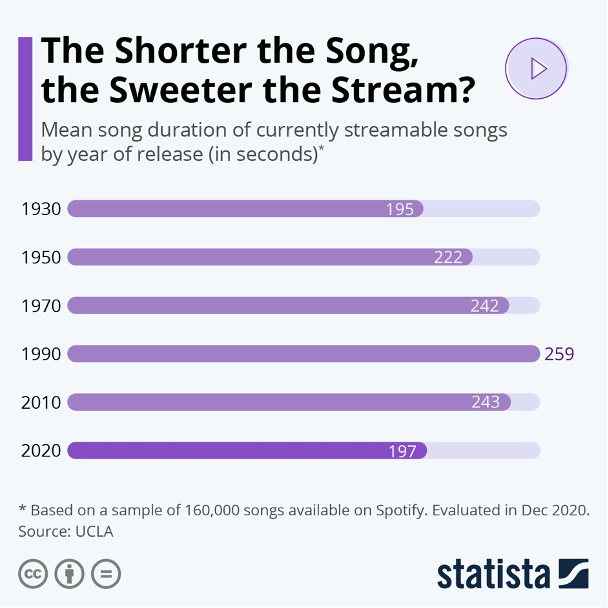
While this cultural fragmentation has eroded deep listening, streaming’s economic structure has simultaneously undermined the albums creative foundation. Artists are now paid by the stream, not by the album, incentivising the release of constant singles and shorter tracks to maximise play counts. On average, a musician earns roughly $0.003-$0.005 per stream (Spotify, 2025), making financial survival dependant on millions of plays rather than cohesive artistic output.
This model requires quantity over quality. Artists release singles every few months to stay visible within algorithmic feeds, rather than crafting albums every few years. Three-minute hook-driven singles dominate because it maximises engagement metrics. As Hesmondhalgh (2021) observes, streaming promotes “functional listening” – music as a utility rather than art – replacing contemplation with convenience.
Even albums that still appear are often engineered for algorithms rather than the artistry. Drake’s Scorpion (2018) and Certified Lover Boy (2021) contain over 20 tracks each, designed to inflate streaming numbers rather form cohesive narratives. In this landscape, albums risk becoming marketing tools – packaging for singles rather than unified artistic statements.
Defenders of streaming culture counter that the album has not died, but evolved. They point to the resurgence of vinyl, the rise of concept-driven visual albums and the flexibility of storytelling. Reports by the Entertainment Retailers Association (ERA, 2025) reveal that while streaming dominates listening, vinyl sales have simultaneously reached a 20-year high, suggesting enduring demand for tangible, full-length works. Millions of listeners still engage with albums by Taylor Swift and Ariana Grande in sequence and some recently released projects still maintain the album’s essence, such as Lorde’s Virgin, suggesting that narrative projects still retain emotional value.
Moreover, artists like Beyonce and Frank Ocean have reimagined the album for digital space. Visual album’s like Lemonade and Endless combine sound, image and narrative to create immersive multimedia experiences. Guo (2023) argues that these innovations signal transformation, not extinction: the album’s function is shifting from a physical artefact to a digital storytelling medium.
Yet even this optimism has limits. While some artists push boundaries, they are exceptions within a system that rewards uniformity. Vinyl’s revival, though symbolically powerful, accounts for less than 5% of global music revenue (ERA, 2025). It functions as a collectors object, rather than a mainstream mode of engagement. Similarly, cohesive albums by major artist stand out precisely because they are rare – nostalgic gestures in a landscape built for playlists and singles.
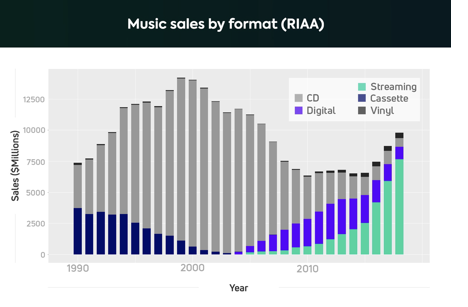
If the album is not entirely dead, it survives as a ghost of its former self – revered, referenced but rarely lived. It’s economic, aesthetic, and cultural foundations have eroded under the weight of algorithmic efficiency. Streaming has not merely altered distribution; it has changed what it means to listen.
The playlist and the algorithm have replaced the artist as curator. The single has replaced the album as a dominant creative unit. Music has become background noise – fragmented, endless, and disposable. While some listeners and artists cling to the album out of nostalgia or prestige, they do so in a marketplace that no longer rewards patience or narrative immersion.
The streaming revolution promised democratisation but delivered fragmentation. It opened the floodgates of access yet drowned artistic coherence in data. To mourn the album is to recognise what has been lost: an art form that once demanded patience, immersion and intention. In it’s place stands an algorithmic soundscape optimised for sameness and speed.
Streaming has not evolved the album – it has erased it, leaving behind only echoes of what artistry once meant in music. And yet, in these echoes, a quiet resistance persists. Independent musicians and vinyl revivalists continue to champion the long-form experience, crafting records that reject algorithmic logic in favour of storytelling and cohesion. These projects may never dominate the charts or playlists, but they carry symbolic weight – a reminder that depth can still exist within the noise.
Ironically, the very technology that dismantled the album also preserves it’s memory. Archival playlists, anniversary reissues and algorithmic “classic album” recommendation keep the format alive as a cultural heritage rather than living practice. The album’s afterlife is one of remembrance – a digital museum exhibit visited by those seeking connection in an age of constant distraction. The album survives not because it is everywhere, but because it resists – a symbol of purpose in a time of endless scrolling.
Perhaps the albums true legacy lies not in it’s survival, but in it’s influence. Even within fragmented platforms, artists borrow the language of albums – sequencing singles into “eras”, crafting visuals that evoke concept records and framing short projects as cohesive statements. The album’s spirit lingers as a blueprint for meaning in music, reminding both creators and listeners that art, at it’s best, is more than a collection of data points. It is an experience – one that asks us to listen and not just hear.
 Guan QiuYu
  REN Ren
  Tan Kane